March MBA: Rock bands and gym owners
TL;DR
Many businesses fail not because the business is hard, but because the wrong people start them; whether your market is problem-aware and solution-aware determines your entire marketing strategy.
Why many (some?) businesses fail
Probably it's not the business.
In recent weeks, I read that restaurants and gyms are among the businesses with the highest failure rates.
My first thought was: "Well, obviously: low margins, low customer LTV, and complicated
management."
Then I thought about Hormozi, who built an empire starting from gyms.
I turned the statistic around and asked myself: "How many people open a gym and study like Hormozi did?
How many take marketing courses and test strategies?"
Well, not many...
(not statistically significant personal observations follow)
In Italy, the person who opens a gym usually has a passion for fitness, maybe a degree in Sports
Science,
but almost never any interest in marketing, business, or management.
Same with restaurants: in Italy they are often family-run, or the dream of an owner who studied
hospitality.
It seems to me that the real problem isn't the difficulty of the business itself, but the misalignment
between the skills it requires and who self-selects into it.
Gordon Ramsay created Kitchen Nightmares around exactly this: "It was the first insight into
the danger of playing at running a restaurant" (Being
Gordon Ramsay, Ep. 3)
Sure, those businesses are tough, but anyone with any business acumen at all knows there are far more
convenient opportunities out there, with higher margins, better returns, simpler operations...
What I mean is: no business analyst would ever choose to open a gym over any other venture.
It would be like a rock band founded by 5 business analysts.
The P-S awareness framework
Listen to the customer because they know what they want... except when they have no idea, in which case you have to tell them.
├─ The writing coach experience
I worked with a writing coach whose main problem is the product: it's not suited to the market.
The Italian writing market consists of online courses and paid contests where, if you win, you
might be published by a small publisher. Meanwhile, the product we worked on is a year-long
mentorship
program in which the client is trained and supported in the creation of their novel.
If it sounds better than an online course, it's because it is better than an online course.
The basic idea is simple: you work one-on-one with a coach for a year, and by the end, you have a novel.
The feedback is tailor-made (not a multiple choice test), the guidance is hands-on (not a playlist of
videos), and the result is tangible.
The marketing practically takes care of itself... and yet it doesn't work.
To make sense of the situation, I created a framework based on the awareness model.
├─ The Problem-Solution (P-S) awareness framework
With this framework, I aim to connect the market and the product along two dimensions: problem and solution.
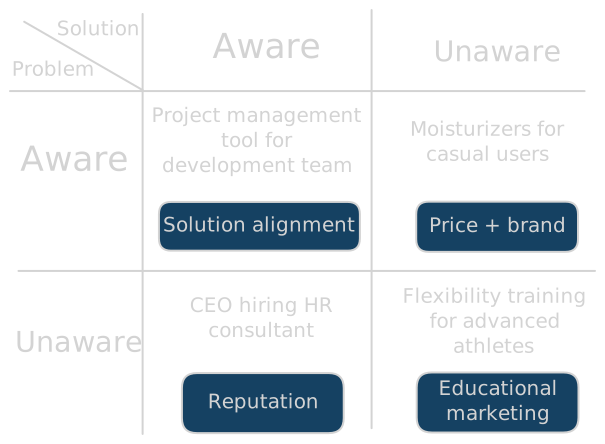
A market has a certain level of understanding of the problem the product solves (problem
un-/awareness) and a certain level of understanding of the solution (solution
un-/awareness).
In this framework, the market is just as important as the product: a product in a different niche has a
different level of P-S awareness.
Meaning of "aware"
Here it's not just "knows" vs. "doesn't know", it's a spectrum.
Someone can be "solution unaware" in many ways:
- they might not know a solution exists at all;
- they might know it exists but not understand how to evaluate it;
- they might understand it in theory but not know where to buy it;
All of these count as "unaware" in this framework, because the customer can't make an informed decision on that dimension.
└─ Examples
├─ Aware - Unaware
Moisturizers for people who aren't "enthusiasts" of cosmetics all seem the same (solution
unaware). But when their skin gets chapped, they know they need to buy a moisturizer (problem
aware).
In this specific case, "solution unaware" does not mean that it is unaware that a solution exists,
but
rather that it cannot distinguish one product from another.
├─ Unaware - Unaware
After years of training, I reached above-average hamstring flexibility, then hit a wall. I had tested
dozens of exercises and stretches, which taught me the complexity of the hamstrings: muscles, tendons, and
joints all interact, and I couldn't isolate what was actually limiting me. Something wasn't right, and no
solution I found seemed to address it.
Here, there is clearly a problem and probably a solution, but neither can be identified.
├─ Unaware - Aware
A CEO notices employee turnover is high but doesn't know why (bad culture? low pay? poor management?).
But they know the move is to hire an HR consultant.
In this case, there is an understanding of the solution, but no understanding of the problem.
├─ Aware - Aware
A development team looking for new project management software knows exactly what the problem is (scattered tasks, ticket management...) and is already familiar with the solutions available on the market (Notion, Linear, Asana...).
├─ The writing coach in the P-S framework
The writing product I was working on falls into the "unaware-unaware" category for the Italian market of
aspiring writers.
The idea behind the product is: "There is a right way to write a good novel, and it can be
learned."
It has several aspects:
- There is one right way (= the narrative model); all others are wrong
- Not all novels are good: only those that follow the narrative model
- You can learn the right way to write, but it takes time, dedication, and effort
This means that:
- Problem side: the customer must accept that there is a correct way to write; that there is an objective distinction between good novels and bad ones; and must actually want to learn (not just wanting the label "writer").
- Solution side: the customer must accept that writing can be taught; and that learning a "style" is not the same as learning to construct a novel.
But the market works in the opposite way:
- Problem side: In Italy, people believe that to write a novel "all you have to do is look within yourself" (a legacy of last century's literature). The principle of authority prevails: winners of writing contests are automatically considered top-quality writers (most of which are not, based on storytelling metrics). Most aspiring writers don't want to learn: they want the illusion of learning, to tell their friends "I'm taking a writing course."
- Solution side: the only keyword is "creative writing," a catch-all term that communicates nothing about what you'll actually learn; everyone knows they "have to take a course," but no one wants guidance on how to construct a novel, because "a novel is something that comes from within."
Compared to the market, therefore, we found ourselves in the U-U quadrant.
"Creative writing" and style courses, within the same market, fall into the U-A quadrant: aspiring
writers don't understand the real problem (they think writing is purely subjective), but they know what to
buy
("a creative writing course").
This is why brand and reputation dominate that segment: the customer can't evaluate the product, so they
pick the most visible or most authoritative option.
U-A is much easier to manage than U-U, because you don't need to educate the customer on the solution;
you just need to be the default choice.
This was my experience in U-U.
But every quadrant has its own rules, and knowing which one you're in changes how you need to act.
├─ Playing the quadrant you're in
Note that you don't have to fight the quadrant you're in. Sometimes the smartest move is to redefine your niche until you land in a quadrant you can afford to compete in. If you're stuck in U-U and don't have the budget for behavioural change, look for a smaller audience that's already A-A for your product.
├─ U-U
Challenge: the customer doesn't know they have a problem, and doesn't know how to solve it if they
did.
Strategy: educate about the problem first. Only once the customer accepts the problem exists,
introduce
the solution. Marketing should communicate "what you should be doing (and what you shouldn't)" before
selling "here's how to do it."
Example: Matthew Smith did this perfectly, and convinced me to buy his product.
This is the hardest quadrant because it requires behavioural change: you're not just selling a product,
you're
asking the customer to abandon a belief.
In a writing market perceived as so "subjective" ("My book comes from within; there can be no
method"), it is extraordinarily difficult and expensive (and probably not suited to my skills).
├─ U-A
Challenge: the customer knows WHAT to buy but not WHY. They're buying a category, not solving a
problem.
Strategy: reputation and brand recognition dominate. The customer can't evaluate whether the
solution fits
their (unknown) problem, so they pick the safest, most visible option: being the "default choice"
matters more than being the best choice. Hence, marketing should focus on visibility, trust signals,
and category leadership.
Example: No small consulting firm gets hired as long as McKinsey exists, not because McKinsey is
better,
but because the client can't tell the difference.
├─ A-A
Challenge: the customer knows their problem and knows the landscape of solutions.
Strategy: specificity wins. The more precisely your solution matches the customer's problem,
methods, and
philosophy, the more likely they are to choose you. Marketing should focus on differentiation: "we solve
X in
THIS specific way, for THIS specific type of customer."
Example: a development team choosing project management software. They know the problem
(scattered tasks,
poor ticket management) and know the options (Notion, Linear, Asana). The decision comes down to which tool
best fits their workflow.
├─ A-U
Challenge: the customer knows their problem but can't distinguish between solutions, the products all
look the same. Also: since the customer doesn't deeply understand the solution, they can't assign value to
it
and pricing becomes guesswork.
Strategy: price and brand visibility are the dominant levers. When customers can't evaluate
quality, they
buy the cheapest option or the one they've seen advertised.
Example: non-cosmetic enthusiast with chapped skin buying a moisturizer. They know the problem,
but all
moisturizers look identical to them. They grab the cheapest one, or the one they saw on TV.
└─ Concluding remarks
I've often used Claude to research the best products in areas I'm not particularly interested in
(moisturizers, bath products...).
I believe this is one of the key applications of LLMs: searching the market for the best product to meet
specific needs, effectively eliminating the "solution-unaware" column.
This aligns with a broader trend in Europe: making consumers solution-aware by regulation. Nutri-Score, for
instance, was designed to let shoppers compare nutritional value at a glance, turning a solution-unaware
purchase ("all cereals look the same") into a solution-aware one ("this one scores A, that one
scores D"). LLMs do the same thing, but on demand and for any product category.
The U-U quadrant is the hardest to manage also because the target audience shapes it.
When people lack deep knowledge of both the problem and the solution, their purchasing decisions are
driven
by who they are as people: their biases, their cultural defaults, their susceptibility to authority, their
tolerance for complexity.
In A-A, the customer's competence does most of the work: they evaluate, compare, and choose rationally.
In U-U, competence is out of the picture, and what's left is personality and identity.
This is why the same product can thrive in one market and die in another.
Hormozi
presents a snapshot of the market based on how much information a customer needs to receive before
making a purchase:
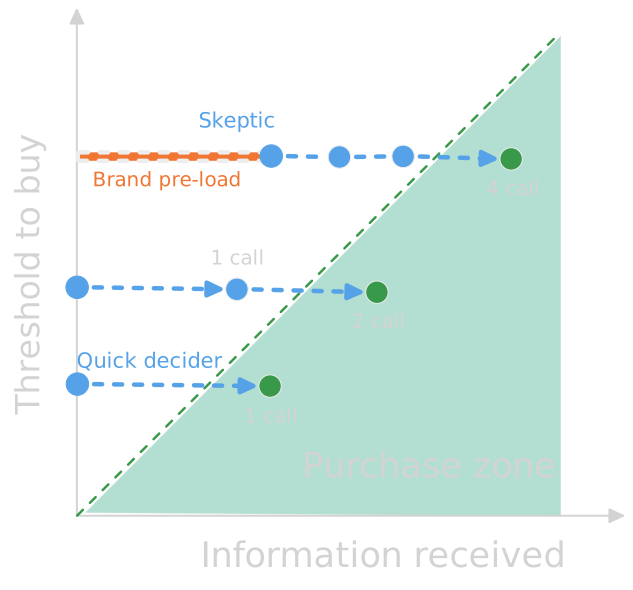
Hormozi's model implicitly follows the awareness ladder: the customer needs to be informed before
buying, and different customers need different amounts of information.
My framework doesn't operate the same way: it addresses different awareness situations with different
strategies, where educating is only one of four.