July MBA: A sex education post
TL;DR
Marketing agencies sell unverifiable quality, so they invest in signalling instead of results; and selling B2C vs B2B is the same split as modelling a fluid from fixed observation points vs tracking every single particle.
Marketing is like teen sex
Everyone talks about it, everyone wants to do it, no one knows how to do that, and even a poorly-made
handjob is better than nothing.
18-year-olds don't want to have good sex, they just want to have sex.
Similarly, companies don't want "good" marketing, they just want to "do marketing".
They want to turn a skill problem (hiring competent people, managing them, increasing costs...) into a
simple money problem: paying a marketing agency.
Right now I'm working on a marketing product, so we're attending local marketing workshops and events, where
the same 2–3 big players are always present.
The case studies they present are always of questionable quality:
- "Okay" websites, on par with Lovable quality-wise, that took 6–9 months to build and cost God-knows-how-much
- Generic promotional videos that fail to convey the product's value, sometimes explicitly (and poorly) created using AI
- Billboard ad campaigns where I literally couldn't figure out what they were promoting
Always with the founders/speakers in fancy suits, Silicon Valley-style offices, and endless buzzwords in the
slides.
I've yet to walk out of a marketing workshop NOT pissed off.
The issue is as simple as you imagine: companies buy the marketing agency's brand and that 🤏 level of skill
in managing social media.
What drives me crazy is that they don't buy into the results: no one cares about CAC, conversion rates,
ROAS... I haven't heard any marketing agency mention them yet.
In a market where objective data exists to evaluate the service, no one knows how to do it or wants to
do it.
In the specific case of Italy, this is a delightful mix of:
- everyone is afraid of social media; no one knows how to use it or wants to learn how to use it (not even for marketing)
- no one knows how to do marketing, and no one knows what a healthy ROAS looks like for their own situation
- the classic Italian work-related indifference: "It's not my job, I don't care" (their job is to keep their job)
This turns marketing agencies' services into a credence good: impossible to evaluate before or after the
service is provided, and pushing good agencies out of the market.
Agencies aren't motivated to improve the quality of their service, but rather to boost their credibility.
Their workshops turn into "complex demonstrations of advanced marketing strategies" (at one
workshop, it took them an hour to explain the strategy behind a website that took 9 months to build... any
16-year-old could do a better job using Lovable in 1h).
Their websites fill boomer decision-makers with animations that make them say "Oh, wow, these guys
are cool".
Their employees are "experts" even though they have ZERO experience (I could link to so many marketing
agencies in Bolzano...).
In short: being the gatekeeper is their business model.
And it's incredibly easy!
Because even a terrible result is still progress when it's the first marketing experiment!
And when the corporate decision-maker just wants to please the boss who asked him to hire a marketing
agency.
And when companies fail to recognize agencies' incompetent use of AI (they literally paste ChatGPT
prompts into Higgsfield, just like in a workshop I attended).
And when nobody in Italy does sex marketing.
What's the moral here?
I'd say signaling theory: if quality is unverifiable, the rational investment is in
the signal, not the product.
But backwards: heavy signaling is not a credential.
Surely Nietzsche wrote "God is dead" after attending a marketing workshop.
B2C : B2B = Lagrange : Euler
Selling is as easy as fluid dynamics: very.
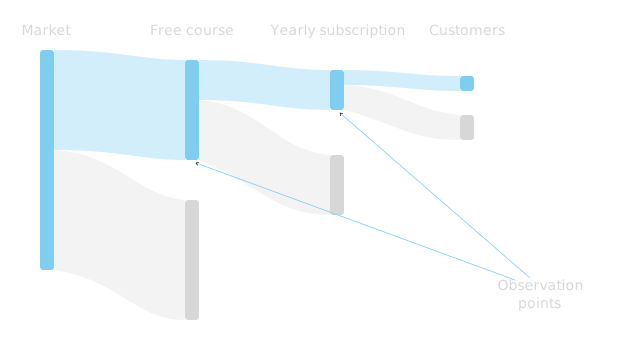
There are two approaches to modeling fluids: tracking every particle (Lagrangian), or fixing observation
points and measuring what flows through them (Eulerian).

Since gaining experience in both B2B and B2C, I noticed the mental model I use maps exactly onto fluid
modeling.
In B2C, you have many buyers, and you can't track each one.
It's a price-taking situation: the seller creates the offer, sets the price, and broadcasts the
proposition to the market.
The market can't negotiate, it can only accept or refuse.
To monitor the behavior of many agents (potential customers), you set up fixed observation points
(landing page, checkout, email sequence) and measure aggregate flow: conversion rates, churn,
click-through.
You read buyer behavior indirectly, through patterns in the dashboards, and post-rationalize the
reasons behind purchases and rejections.
In B2B, you have few deals and you can (must) nurture them.
It's a bilateral bargaining situation (at least in my experience as a consultant): the proposal
and the price change based on the buyer's needs, and every negotiation is unique.
Selling happens (usually) face to face, adapting live to the potential buyer's requests: it's a game of
reading the room, not post-rationalization.
Even more than a psychology mindgame, the negotiation becomes a strategy challenge: in B2C, money,
decision-power and perceived value converge in a single entity (the buyer); in B2B, the money doesn't belong
to the person making the purchase, the value is not perceived by the person giving the ok, and the need isn't
felt by the person negotiating the price.
The hierarchy fragments the decision across the incentives of different stakeholders (the head wants to
meet KPIs, the production manager doesn't want to go over budget...).
The selling approach shifts from mass flow controller to live chess strategy.
When the B2C I worked on didn't work, the problems were:
- Our assumptions about the market were wrong
- We weren't following the incentives imposed by the market
- (As a consequence) we picked the wrong target
Bottom line: we had no grasp of the big picture because... we built a product and a funnel without a market
study, with no data to guide us.
When consulting deals fell through, it was always a negotiation problem:
- I was too technical in my explanations
- I didn't understand what the client needed (sometimes the other side didn't help either)
Bottom line: I had to learn not to be the classic nerdy technical founder who can't talk to people.
The fix was (obviously) exposure therapy: after local conferences, presentations, and networking events
where I forced myself to talk to professionals... well, I'm better now ;D.
See? Told you it's easy.